

Why write a Bitcoin FAQ here?
This publication is mostly about Bitcoin-era investing, Strategy/MSTR, Bitcoin treasury companies, valuation, incentives, risk, and capital allocation. But that creates a problem: if you are coming from traditional finance, you may understand public companies, balance sheets, ETFs, preferred stock, dilution, and capital structure while still not fully understanding Bitcoin itself.
That matters because Strategy is not comprehensible unless Bitcoin is at least partly comprehensible. Strategy owns bitcoin. It raises capital to buy bitcoin. It measures itself, increasingly, by how much bitcoin is attributable to each share. If Bitcoin is nonsense, Strategy is nonsense. If bitcoin is a serious monetary asset, Strategy becomes a much more interesting capital allocation case study.
So this is the Bitcoin foundation. Not the technical version. Not the maximalist version. A plain-English version for investors who want to know what Bitcoin is, why people think it is valuable, what can go wrong, and how to think about it without pretending it is either easy to hold or worthless.
What is Bitcoin?
Bitcoin is a decentralized monetary network. The asset, bitcoin, is the monetary unit of that network.1
The simplest description is that bitcoin is money issued by a decentralized protocol rather than by a central bank. No government, company, or person can decide to create more bitcoin because it would be politically convenient. Both the total supply and the issuance schedule are coded in the rules of the network, and users running Bitcoin software enforce those rules.
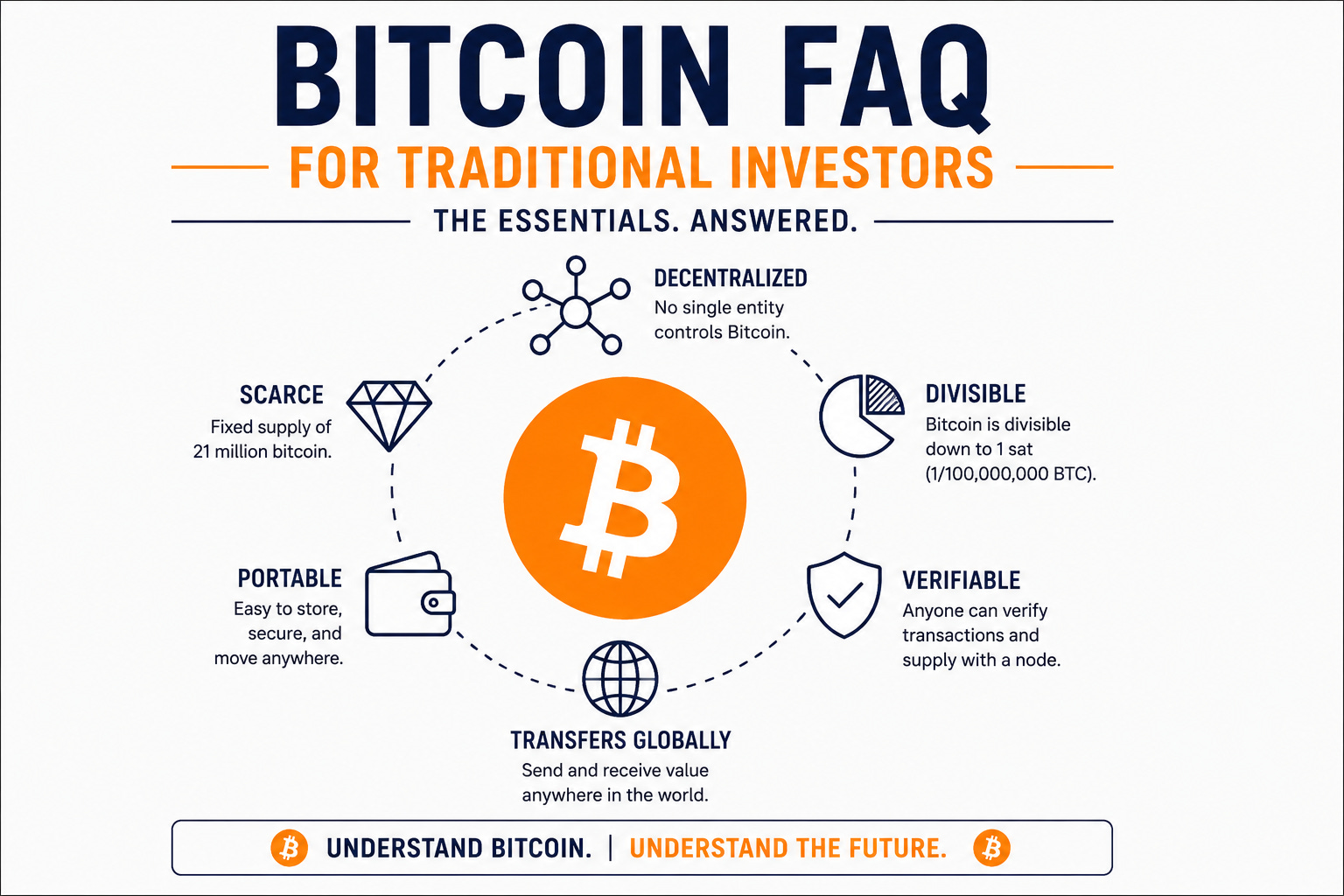
That is why bitcoin is often compared to digital gold. The comparison is imperfect, but useful. Gold is valuable partly because it is scarce, durable, hard to counterfeit, and not someone else’s liability. Bitcoin attempts to improve on those monetary properties in digital form. It is scarce, divisible, portable, verifiable, and transferable across the internet without reliance on any trusted third party (like a bank or a government).
What problem is Bitcoin trying to solve?
Bitcoin is trying to solve the problem of money that can be debased.
Most modern money is fiat money. It is issued by governments and central banks. That system has advantages, especially in a crisis, but it also means the supply of money can expand by political and institutional decision. When the money supply expands faster than the supply of scarce goods, services, and assets people actually want, the purchasing power of each unit of currency tends to fall over time.
That decline is not always obvious day to day. It may show up as higher prices for houses, stocks, land, education, healthcare, art, or other scarce assets. It may be partially hidden by technology making some goods and services cheaper. But the basic point remains: if you save in a currency that can be expanded without limit, you are trusting the issuers of that currency to protect your purchasing power.
Bitcoin offers a different bargain. It does not promise stability in USD terms. In fact, it is famously volatile. What it offers is a monetary asset with a fixed total supply and a fixed issuance schedule that cannot be changed by a central bank meeting.
Why does the 21 million supply cap matter?
Bitcoin’s supply is capped at 21 million bitcoin. That does not mean all 21 million exist today, and it does not mean new bitcoin issuance has already stopped. New units of bitcoin are still issued to miners as part of the block reward. But the issuance rate declines over time through halvings, and the terminal supply is fixed by the protocol rules.
After the April 2024 halving, the block subsidy fell to 3.125 bitcoin per block, or roughly 450 new bitcoin per day. That issuance rate will be cut again at the next halving.
This matters because increased demand for Bitcoin cannot be met by increasing supply the way a company can manufacture more cars or a government can issue more currency. If more people want to hold bitcoin, the main way that demand is expressed is through price.
Do I need to buy a whole bitcoin?
No. This is one of the easiest beginner mistakes to make. You do not need to buy one full bitcoin. Bitcoin is divisible into smaller units called sats (short for satoshis). One bitcoin equals 100,000,000 sats.
So the price of a whole bitcoin should not be treated as the minimum investment. You can buy a small dollar amount of bitcoin. The relevant question is not whether you can afford a whole coin. The relevant question is whether bitcoin deserves a place in your portfolio, and if so, how large that place should be.
What makes bitcoin different from gold?
Gold has been used as money and a store of value for thousands of years. Bitcoin is much younger. That is gold’s advantage. Bitcoin’s advantage is that it is easier to verify, easier to divide, easier to transport, and easier to send across distance.
A person can verify bitcoin with a full node that costs a few hundred dollars to run. Verifying a gold bar is much harder. A person can move bitcoin across borders by remembering or securing a seed phrase. Moving large amounts of gold across borders is a physical and legal problem. A person can send bitcoin to someone else over the internet. Sending gold internationally is slow, expensive, and dependent on intermediaries.
Bitcoin is not literally gold on the internet. It is its own thing. But the digital-gold phrase exists because bitcoin is trying to be a scarce, non-sovereign monetary asset for the internet age.
Who controls Bitcoin?
Bitcoin is best understood as a consensus network. Miners propose blocks. Nodes verify that blocks follow the rules. Users choose what software to run. Exchanges, custodians, wallets, developers, miners, and economic actors all matter, but no single person, company, miner, or government can unilaterally change Bitcoin’s rules.
People sometimes hear that a miner with 51% of the network’s hashpower could attack Bitcoin and assume that 51% of miners can simply vote to create more bitcoin. That is not right. Mining power can affect the ordering of valid transactions and can create certain attack risks, but miners cannot make invalid coins valid if the nodes enforcing the rules reject them.
How does this connect to Strategy/MSTR?
Strategy matters because it took the Bitcoin thesis and made it a public-company capital allocation strategy.
A spot Bitcoin ETF holds bitcoin. Strategy owns bitcoin too, but it also has a capital structure, a management team, an operating business, debt, convertibles, preferred stock, and common equity issuance. Strategy is trying to use public capital markets to increase the amount of bitcoin attributable to each share over time.
That is why the Bitcoin foundation matters. If bitcoin is just a speculative token, Strategy is hard to defend. If bitcoin is a serious monetary asset, then Strategy becomes a live experiment in Bitcoin-era corporate finance.
So what is the shortest version?
Bitcoin is a decentralized monetary network with a fixed supply schedule. The asset, bitcoin, is scarce, divisible, portable, verifiable, and transferable across the internet. It is volatile and young. But it also gives investors exposure to a monetary asset that cannot be debased by political decision.
That is the starting point. From there, the question becomes whether Bitcoin belongs in a portfolio, how to size it, how to hold it, and how to think about companies like Strategy that allocate capital around it.
Want To Read Further? Start here:
This is a good place to note that the Associated Press (AP) Stylebook explains that when spelling Bitcoin you use a capital B (Bitcoin) when referring to the network, the protocol, the software, or the concept as a whole and a lowercase b (bitcoin) when referring to the actual currency unit, payment, or individual digital coins.