

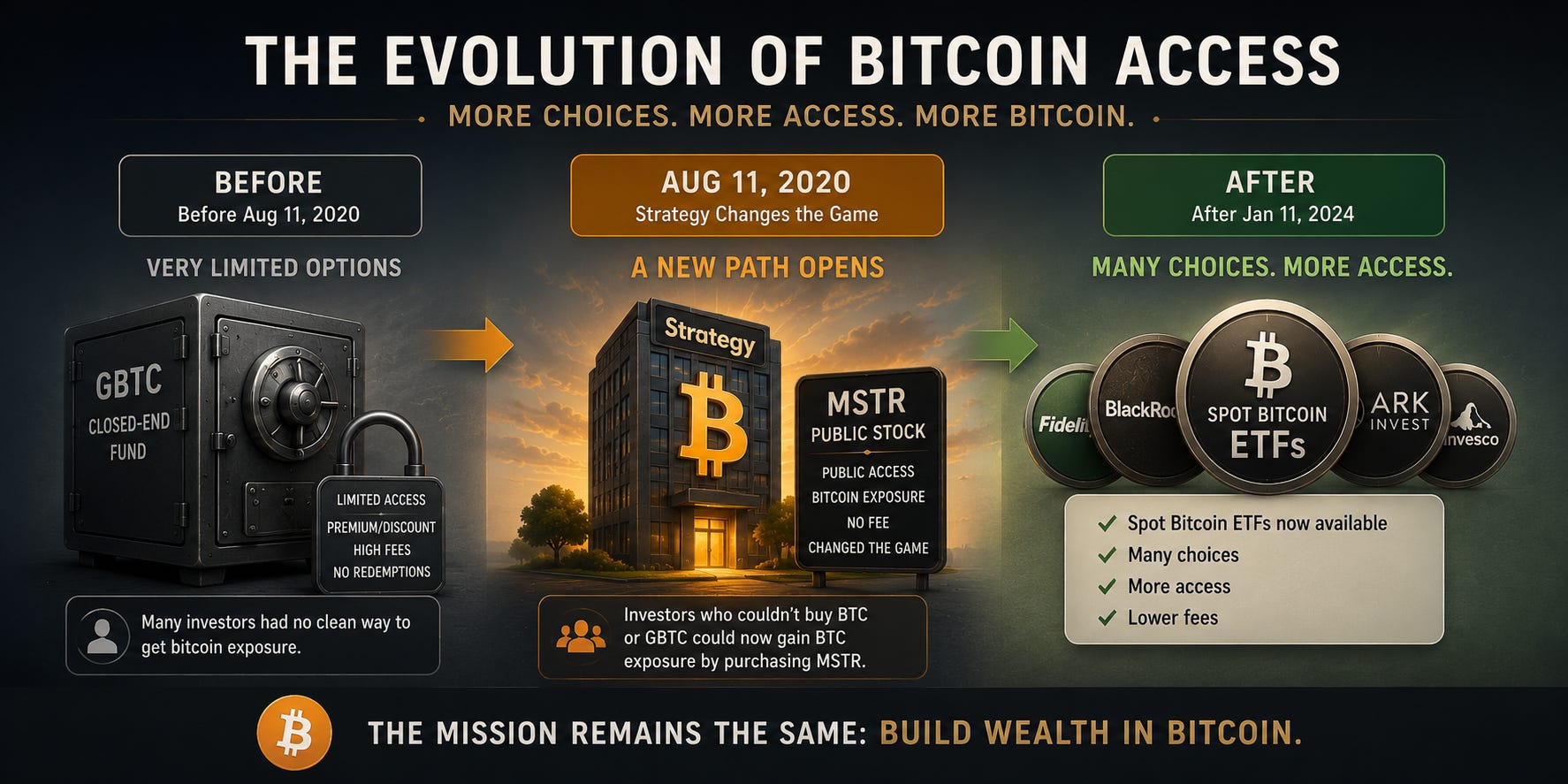
Strategy, formerly MicroStrategy and still traded under the ticker MSTR, is what is now often described as a bitcoin treasury company. When Strategy announced its first bitcoin purchase on August 11, 2020 and became the first publicly traded company to make bitcoin its primary reserve asset, it gave a lot of individuals, institutions, and other entities a chance to gain bitcoin price exposure they never had before.
At the time, there was no approved spot1 bitcoin ETF. Before Strategy bought its first bitcoin, many investors had no clean way to get bitcoin exposure in a brokerage or retirement account. If you could not buy bitcoin directly because the fund you managed was not permitted to own it, or because your retirement account did not allow it (which was true of the vast majority of retirement accounts), then your options were limited. One of the few public-market vehicles was Grayscale Bitcoin Trust, which traded over the counter under the ticker GBTC. GBTC was legally a trust, but before its ETF conversion it functioned like a closed-end bitcoin fund. Investors could buy and sell shares, but ordinary shareholders could not redeem those shares for the underlying bitcoin. That structure mattered because GBTC often traded at a premium or discount to the value of the bitcoin it owned. And even then, many funds and retirement accounts were precluded from buying it.
For instance, personally, with my 401(k) plan at my job, I was precluded from buying GBTC. At the time, my 401(k) plan did not even allow me to buy individual stocks. So the only way to gain any exposure to bitcoin’s price at all was to find a mutual fund that owned GBTC. Of course, it meant price exposure to everything else in the mutual fund at the same time. Eventually, I found some funds by Kinetics2 that had a large exposure to GBTC. So I dumped my entire 401(k) into their funds.
Then on August 11, 2020, Strategy changed the game. By purchasing bitcoin and making it Strategy’s primary reserve asset, any individual, institution, or other entity that could not buy BTC or GBTC but could buy individual stocks could gain exposure to BTC’s price by purchasing MSTR. So that’s what many did, including myself. While I owned GBTC in my Roth IRA, I also added MSTR to it on September 18, 2020. Then later, when my 401(k) plan changed the rules and allowed me to buy individual stocks, I sold all my Kinetics funds and bought MSTR.
It was around this time I had to contend with what Strategy was and was not, especially as it concerned my Roth IRA where I could own either GBTC or MSTR but not spot bitcoin. At the time, Strategy was earning about $100 million in free cash flow (FCF) annually, later decreasing to about $70 million. It had a profitable but non-growing software business, and still has the software business to this day.
So there was GBTC, which functioned like a closed-end fund. Bitcoin could be added to the trust in exchange for shares of GBTC, but ordinary shareholders could not redeem their shares for either spot bitcoin or even an equivalent value in USD. GBTC also charged a fee. Then there was Strategy, this profitable but non-growing operating company that was putting its FCF into BTC. Like GBTC, you had no specific claim to the underlying BTC, but unlike GBTC it had an operating company and no fee. It’s a very different structure, and this is the structure the current bitcoin treasury company model was built on. To this day, Strategy has an underlying software business that’s likely valued in a few billion dollars.
Before the spot bitcoin ETFs launched on January 11, 2024, these two vehicles, GBTC and MSTR, were effectively the only way many large-scale institutions and individuals whose retirement accounts limited their options could gain BTC price exposure. That’s no longer true. Now, many institutions and individuals are deciding to buy one of the many spot bitcoin ETFs instead of buying MSTR. (GBTC has been converted into a spot bitcoin ETF, but because of its very high fees compared to other spot bitcoin ETFs, I would not buy it today. If you already owned GBTC before the launch of the spot bitcoin ETFs, and there are large taxable gains built in because the GBTC position is held in a taxable brokerage account, it may make sense to keep it.)3
During that same pre-ETF period, I came to realize that the most important thing for increasing my long-term net worth in USD terms was increasing my net worth in bitcoin terms. That’s when I, along with Michael Saylor (and many others), came upon the same insight: the importance of understanding bitcoin per share. In Saylor’s case, he applied the idea at the corporate level at Strategy. But we’ll get into that during the next post.
Want To Read Further? Start here:
“Spot” means the ETF owns bitcoin itself for immediate delivery, rather than bitcoin futures contracts, which are agreements to buy or sell bitcoin at a set price on a future date.
The Kinetics funds are also how I discovered Texas Pacific Land Corp. ($TPL), a fascinating company and business. I’m a big fan of TPL, though price always matters. For more diversified investors, it is worth learning about TPL and keeping on a watchlist.
As of this writing, BlackRock’s iShares Bitcoin Trust (IBIT) is the largest spot Bitcoin ETF by assets under management.